
Bi-Directional EV Charging Is Coming — Here’s What Hampton Roads Homeowners Should Know Before It Arrives


For most of the history of electric vehicles, the relationship between the car and the home was one direction: power flows from the grid, through your panel, into your charger, and into your battery. Your car takes. Your home gives.
That is about to change in a significant way. And if you own an EV or are planning to, understanding what bi-directional charging means for your home — before it becomes mainstream — puts you well ahead of a conversation most homeowners are not having yet.
What Bi-Directional Charging Actually Is
Bi-directional charging — also called vehicle-to-home (V2H) or vehicle-to-grid (V2G) depending on the application — means your electric vehicle can not only receive power but send it back. Your car becomes a mobile battery that can power your home during an outage, reduce your energy costs during peak grid pricing, or feed power back to the grid entirely.
The concept has existed in early forms for a few years. What is changing now is the scale at which major manufacturers are building it into mainstream vehicles.
Tesla’s recent expansion of Powershare Home Backup capability to the Model 3 and Model Y — allowing those vehicles to work with a Powerwall to extend home backup power by two or more days — is the clearest signal yet that bi-directional capability is moving from early adopter territory into the standard feature set of modern EVs.
Cyber Truck led the way. Model 3 and Model Y followed. The direction of travel is clear.
Why Your Electrical Panel Is the Foundation of Bi-Directional EV Charging?
Here is what most of the coverage of bi-directional charging leaves out: none of it works without the right electrical infrastructure behind it.
A vehicle-to-home system does not just plug into your existing outlet. It requires a compatible bidirectional charger — sometimes called an EVSE with V2H capability — a transfer switch or smart panel integration to safely isolate your home from the grid during backup mode, and a main service panel that can handle the load in both directions.
For many Hampton Roads and Virginia Peninsula homeowners, the panel they have today was not designed with any of this in mind. An older 100-amp or 150-amp panel that is already carrying a full residential load has limited headroom for the additional infrastructure bi-directional charging requires.
The homeowners who are thinking about this now — who get their panel assessed, who understand what their service capacity actually is, who have a relationship with a certified
EV installer before they need one — are the ones who will be able to move quickly when their vehicle supports it and the equipment becomes widely available.

Where Go Green Electric Stands on This
Judson Clements has been in the middle of these conversations with Tesla directly.
As a Tesla certified installer, Judson attended Tesla’s recent live webinar on Powershare Home Backup with Powerwall — presented by James Bickford, Tesla’s Director of Global Sales for Residential Energy Products, and Senior Product Manager Emily Jantz.
He is currently in the process of receiving Tesla’s updated installer resources on the latest bi-directional capabilities as they roll out to new vehicle platforms.
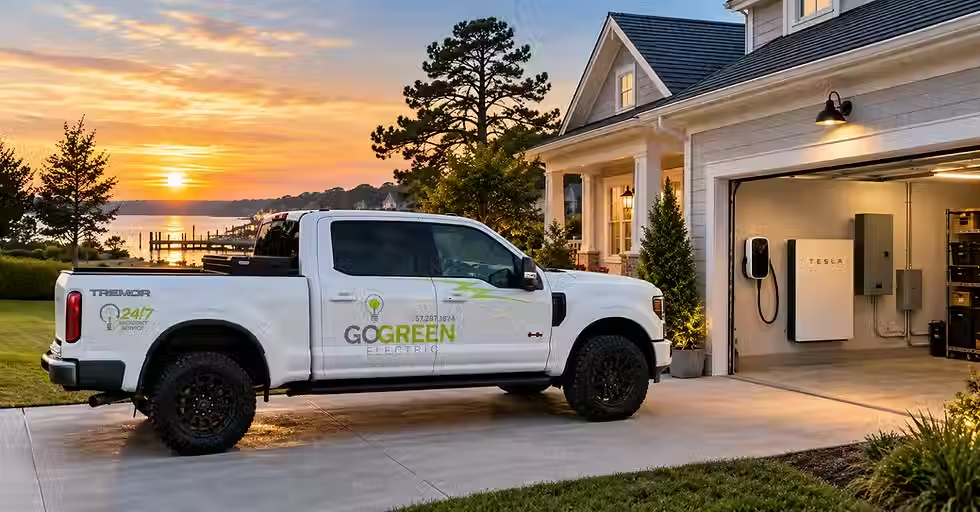
This is not a company watching from the sidelines and waiting for the technology to arrive. This is a certified local installer who is already in the room where these conversations are happening, so that when the technology lands in your driveway, there is someone in Hampton Roads who already knows what to do with it.
Go Green Electric is a certified installer for more than 14 EV charging brands. That breadth matters in a rapidly evolving technology landscape — because the right solution for your home may not be the same as your neighbor’s, and it will almost certainly look different in two years than it does today.
What to Do Right Now
You do not need to wait for bi-directional charging to arrive before taking the steps that make your home ready for it.
Start with a virtual estimate. Judson runs live load analyses during virtual estimates — a free, no-obligation session where you learn exactly what your panel can handle, what headroom you have, and what your home would need to support the next generation of EV and home energy technology.
If you already have an EV charger installed, ask about Charge Care™ — Go Green Electric’s annual maintenance and inspection plan that keeps your charging equipment performing correctly and positions you for upgrades as the technology evolves.
And if you want to stay ahead of developments like this one, sign up for the Go Green Electric monthly email.
The first edition is out now. Real information for Hampton Roads and Virginia Peninsula homeowners who are paying attention to where home energy is going.
Call us at 757-287-1824 or schedule your free virtual estimate online.


Comments